Why Ancestral Veneration Beats Modern “Mindfulness” in a Meaning-Starved World
We have become optically omnivorous.
Through our smartphones, we see the world through a million Argus eyes. Over breakfast we consume a feed of TikTok memes, aerial footage of the day’s wars, and a litany of hot takes from every human perspective.
Many enjoy this monstrous Palantir-like omniscience, and at times I can be one of them.
But, for far too many of us, depression, loneliness, and isolation—and unwanted childlessness—reign, confirming the ironic truth that social media and constant “engagement” make people less connected, not more.
We consume endlessly but remain, somehow, malnourished.
We are starving omnivores.
We ruminate on a constant feed of novelty, a cud of stimulants devoid of nutrients, without any means of Stoffwechsel—metabolic absorption—to transform the streaming spectacle into creative energy or meaning or purpose—into fuel for life.
This hunger for meaning fuels the wellness industry. Mindfulness apps like Calm have entered the scene to fill a growing sense of void.
They promise to clear away distracting stimuli and grant us mental space to hear our own voice amid the polyvocal chorus of daily life.
Perhaps this goal is well-intentioned, yet we have come to question the means of achieving it and, ultimately, aspects of the goal itself.
On the surface, modern “mindfulness” asks us to replace frenetic stimulation with tranquil ambience, to turn inward and attend placidly to our own mental content.
Proponents like Jon Kabat-Zinn define Mindfulness as “the awareness that arises from paying attention, on purpose, in the present moment, and non-judgmentally.”
Yet this approach can perpetuate the very disconnectedness it aims to cure.
Indeed, Kabat-Zinn’s prescription rather reminds me of the “rest-cure” in the short story “The Yellow Wallpaper,” which only exacerbates the narrator’s problematic isolation and monomania.
Besides, the instruction to sit passively and not judge the contents of our thoughts is structurally identical to the supine attitude with which we greet our social media feeds. It polishes a narcissus mirror, redirecting attention from our phones to our minds, to a stream-of-consciousness that, without any intervention, would not be too dissimilar to the contents of the last few items we doomscrolled. In our digital age, our phone feeds largely manage our mental thought-flow. We don’t need another “stream” to passively listlessly enjoy.
When we regard our consciousness and sensory inputs non-judgmentally, we have no way of synthesizing our intake, we have no metabolic absorption. We lack the means of addressing the underlying hunger for meaningful connection. We lack blueprints by which to build a trellis of purposeful growth.
We don’t need more of this passive, “non-judgmental” mental consumption. We need instead the mental technologies of valorization, discrimination, hierarchization, and approbation in order to forge meaning, purpose, and a sense of belonging.
When trying to develop these things, we might well ask: what did the Romans do?
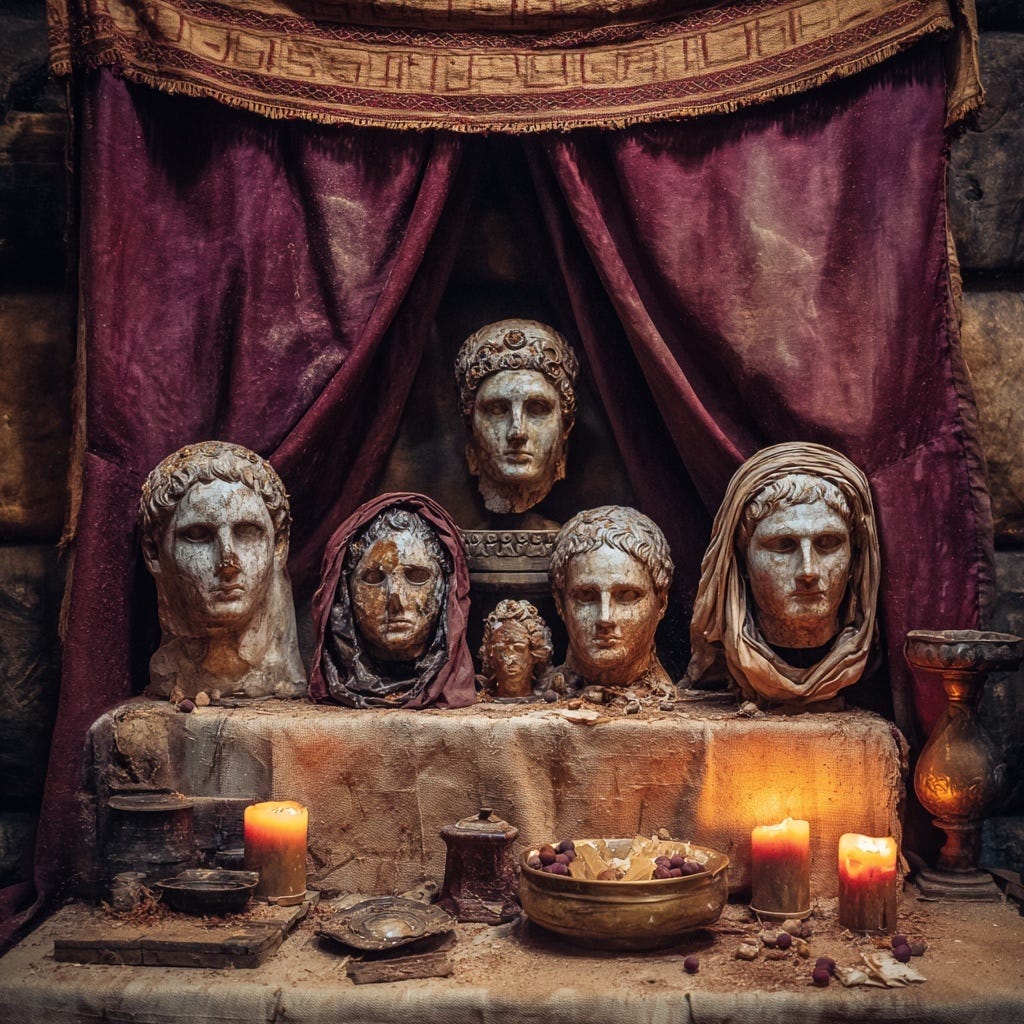
The heart of the traditional Roman house was a sacred theater of lineage. Here were the imagines maiorum—wax death masks of the family’s ancestors—creating a tangible genealogy. Nearby stood the lararium, the household shrine, where daily rituals were performed to the Lares, protective spirits of the ancestors, guardians of the home. This was the focal point for venerating the familial dead, the di parentes, who were considered part of the household’s divine community.
During the February festival of Parentalia, families would process to tombs, making offerings. This would culminate in a joyous feast celebrating familial bonds.
These ritualized remembrances were a form of ancient mindfulness. But unlike the apps of today, they did not aim for a bland acceptance of randomness as would a smiling Buddha in yoga pants. By methodically honoring the familial—touching the masks of ancestors, making offerings at the shrine—the Roman was pulled from daily trivia and quotidian stresses into a practiced awareness of their place within an eternal, multi-generational continuum.
It was a practice that transformed the fear of mortality into a sense of belonging and inherited strength.
Ancestral veneration operates on this more potent premise. Rather than fostering a non-judgmental void, it invites us to engage with a council of elders, a board of directors invested in our well-being. Through their blood and toil, they gave us life; for their investment to thrive, we must thrive. This creates a reciprocal sense of duty and obligation. When we venerate our ancestors, we are no longer atomized units of consumption. We become engaged doers, connected to our history, our genealogy, our ethnos—our thumos.
Most modern ideologies, left and right, from Marxism to libertarianism, promote the sovereign individual as the foundational unit of being. When mixed with materialism’s denial of the non-physical, this creates a double helix of loss: We become rootless things, our cognition easily blown about by shifting cultural winds.
We seek a context, a framework that clarifies purpose and role. Yet modern thought often castigates the very notion of inherent or inherited duties, fixed purposes, or prescribed roles, viewing them as the oppressive trappings of a traditionalism we have outgrown. The result, however, is that without this trellis, we are weeds that never grow skyward.
Ancestral veneration offers that missing trellis.
It counters the enervating atomization of the soul not with a diet of air, but with a substantive feast of identity, purpose, and grounded wisdom.
It populates the mind with a supportive, inter-generational council that provides the context and the vital pretextto pass insightful judgment on our lives, our plans, and our place in the world.
We become, not a starving omnivore, but a cultivator of our own sustenance.
 Scrivner's Pyre