Today I want to talk about the “flat earth” conspiracy theory.
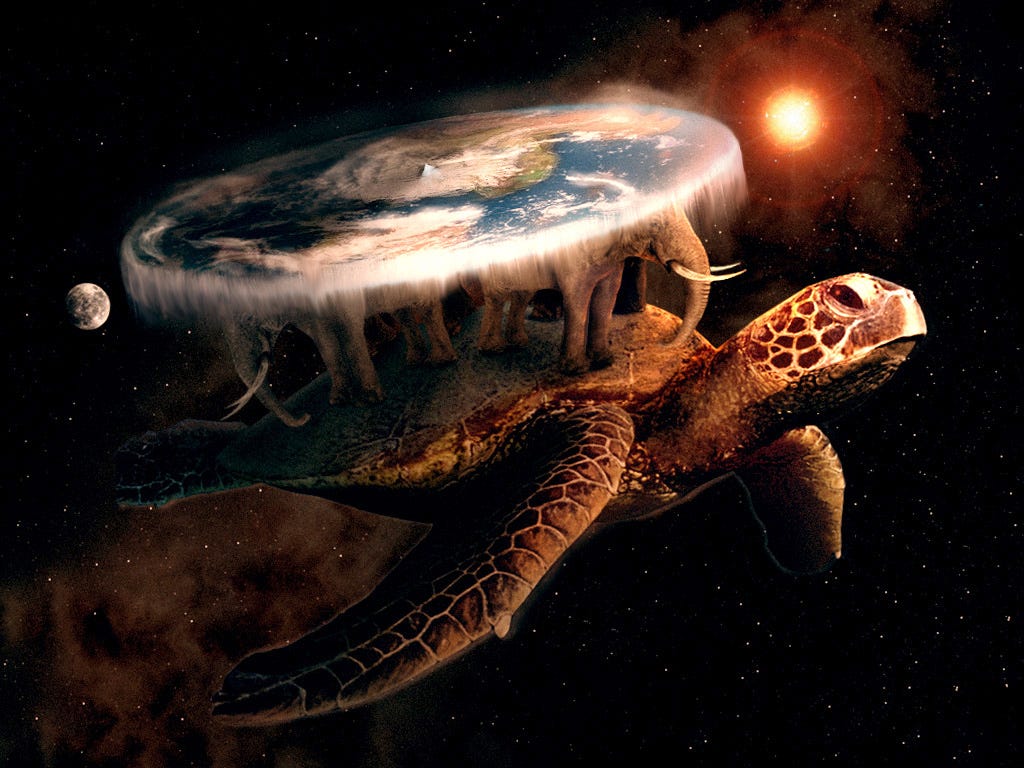
Am I mad? Perhaps.
But, like many of a pagan temperament, I place a high value on poetic as opposed to empirical truth. So, one would think that I have a certain degree of tolerance for “unusual interpretations” of our physical reality—and I do: if the Lenape and Iroquois want to imagine our world on a sea turtle’s back, and they derive purpose or inspiration therefrom, why proselytize the Big Bang to them?
Besides, the Big Bang is just another fanciful metaphor—and one that is of questionable value, especially as it is popularly imagined.
I once spoke with astrophysicist Charles Lineweaver about the “origin of the universe.” According to him, a better cosmogenic metaphor was to be found in a trampoline—the original flat earth.
This flat surface corresponded to a period of extreme uniformity and high energy density—the “primordial singularity.” When the “trampoline” stretched, ripples propagated outward from the point of deformation. These fluctuations in matter and energy density eventually led to the formation of structures such as galaxies and clusters. In his analogy, the trampoline represented the fabric of space-time, not as a rigid structure but rather a dynamic entity that can stretch, bend, and deform under the influence of gravity and other cosmological forces.
For what it’s worth, Lineweaver also had a high opinion of Tolkien’s acoustical cosmology found in the Ainulindalë.
Based.
My point is that we can view the world through countless metaphors, enabling us to gain various non-mutually exclusive and incomplete angles on the elephant, as it were.
Considering all this open-mindedness and willingness to admit poetic license on my part, you can be assured that it is not the physical model of a “flat earth” itself that bothers me about “flat earth conspiracy theory” so much as it is the question of its end goal—its télos.
Integral to the idea of a Flat Earth is that grand conspiracy: apparently, the elite of the world have all conspired to dupe the public into thinking that we live on a spherical world, when in fact, the theory goes, we don’t.
But why would the elite do this? I always stumble over this point. What would anyone have to gain by pulling the wool over people’s eyes in this colossal way? Why this elaborate ruse? Why??
I asked Twitter this question. Most answers were some variation of:
“The flat, geocentric model manifests our lofty position in a God-ordered system. By spreading the heliocentric lie, elites try to get us to forget that we are all God’s children, so we become mere thralls to their materialist system.”
The problem with this answer is that it is woefully ignorant of the history of heliocentrism.
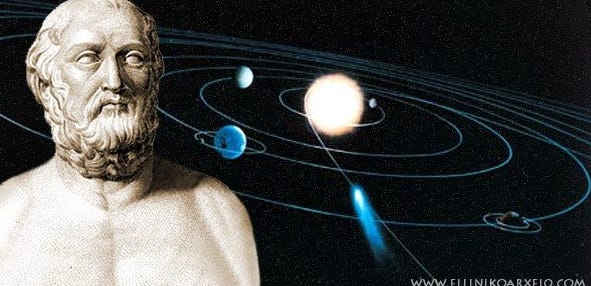
Over 2200 years ago, Greek astronomer Aristarchus of Samos, influenced by Pythagorean cosmology, proposed a model in which the Sun, rather than the Earth, was the central celestial body. But Aristarchus was not trying to pull the wool over people’s eyes to make them cease to believe in the Christian God—because Christianity did not exist yet.
Nor does any extant writing suggest Aristarchus was trying to put us on a spherical world and send us around the sun to get us to reject Zeus. Religious questions seemed to play little part in the ancient debate.
Aristarchus’ heliocentric model did not gain widespread acceptance or popularity in ancient Greece. The prevalent geocentric model, which astronomers like Eudoxus of Cnidus and Callippus supported, postulated that the Earth was stationary at the center of the universe and that celestial bodies were moving in concentric spheres around it.
But some scholars, citing the Orphic Hymns and other texts, have claimed that ideas about the sphericity of the earth and heliocentrism were common among the educated a thousand years before Aristarchus and that these ideas were held even though they were considered impious (asebia) by the more geocentric civic elites of the time.
Note that this is an inversion of what flat-earthers claim is our current reality. Back then, it was geocentric-minded elites vs. marginalized, heliocentric-minded dissidents.
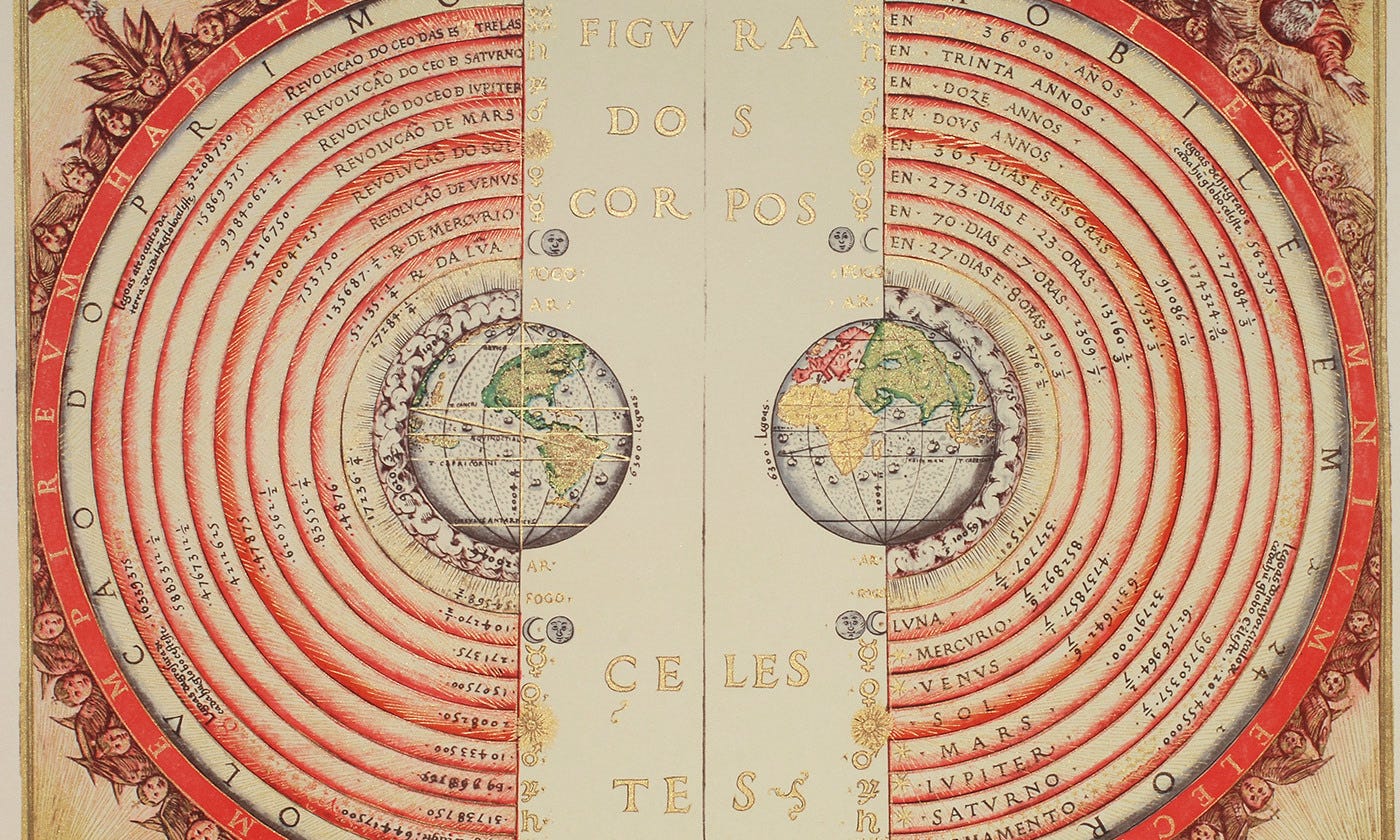
Such was also the case in Galileo’s time; the Catholic Church took Galileo’s support of Copernican heliocentrism as a challenge to its authority. In 1616, the Church issued a formal injunction prohibiting the teaching of heliocentrism as a fact.
Galileo’s troubles further escalated with the publication of his book “Dialogue Concerning the Two Chief World Systems” (1632), which presented arguments for heliocentrism through a fictional dialogue. The book, perceived by some as mocking Church authorities, led to Galileo being summoned by the Inquisition and subsequently put on trial for heresy.
So, the position of the elite has changed. Have flat-earthers explained why? Why did the institutional geocentrism that served the elite for so many centuries get replaced in the age of NASA by institutional heliocentrism?
The truth is, of course, that it doesn’t matter what the theory is as much as it matters who is propounding it. Elites of every age will claim that “the science is settled” or that “history is settled” around issues that perpetuate their institutional power. Rest assured, when you hear these phrases, you are not dealing with an effort to grapple with truth; you are dealing with a system protecting itself from destabilization.
There’s something inherently “flat” about “settled science.” It gathers particulars to its strata, armoring itself from incoming missiles from other angles of perception. That’s why when we speak of getting to the full truth of something, we seek a “rounded” or three-dimensional view. This is partly why Herder thought statues were superior to paintings.
2 The latter could trick the eye, whereas the former admitted the full reality of corporeal form.
Anyway… Clearly, the elite proponents of heliocentrism today are in no way threatened by the flat earth conspiracy theory, seeing that flat-earthers are allowed to voice their opinions on pretty much every online platform imaginable. Dissident “lunar landing skeptics” are free to express their opinions without being banned or demonetized. Clearly, they pose no threat to the system either.
Who really threatens the hegemonic institutional narratives in the West? Ask yourself: Who gets banned from online platforms (and, in some countries, thrown in jail) for speech? What topics do they raise? What “settled science” and “settled history” do they question?
There go the Galileos of today. Those are the “conspiracy theories” that matter.
What Jovian moons are there yet to discover?

The Settled Science
270KB ∙ PDF file
 Scrivner's Pyre