Back to the labyrinth where either we are found or lose ourselves forever.
~W.H.Auden
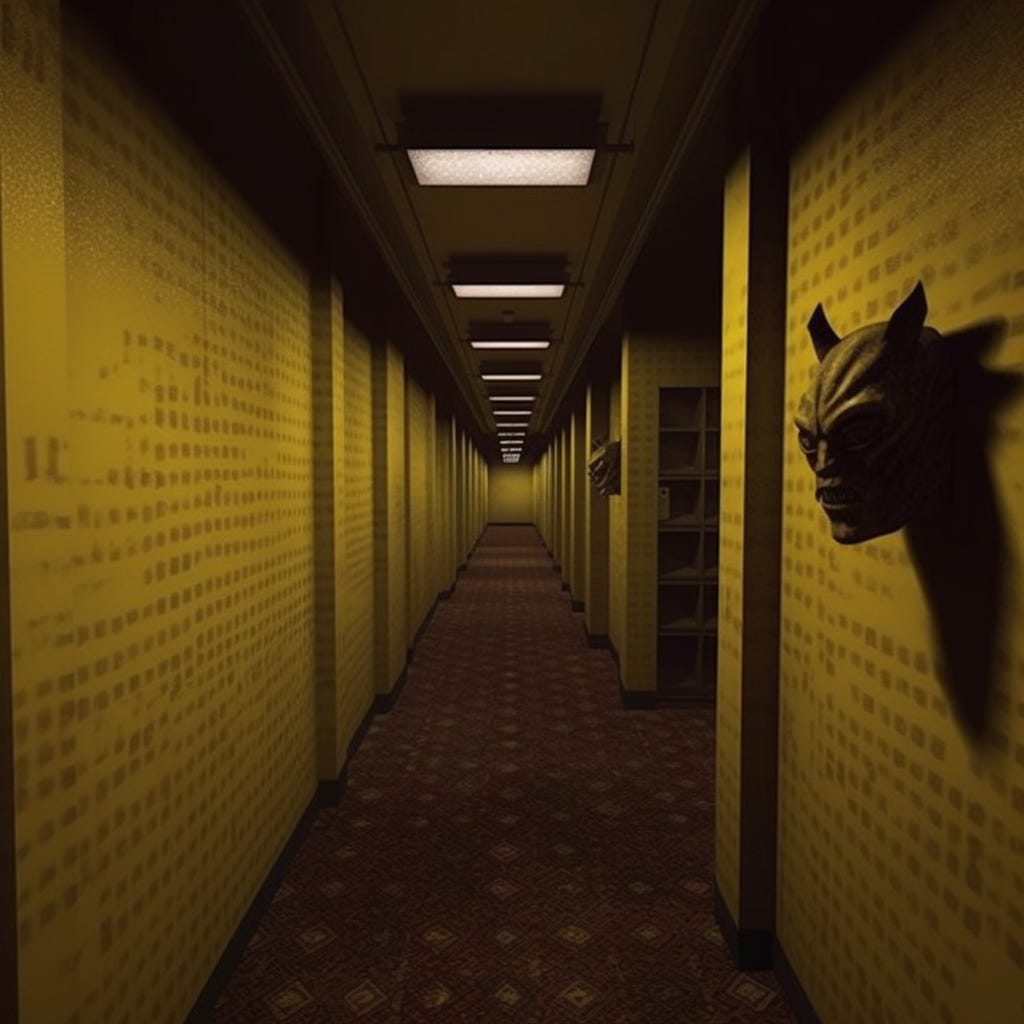
Know Your Meme says “The Backrooms” Internet phenomenon started in 2019. But I have a relative (a first cousin once removed) who insists she’s been going there since at least 2006.
For those unclear about the Backrooms, it is a warren of yellowy walls and halls in what looks like an abandoned office building, documented by found footage from 1990s VHS tapes uploaded to YouTube. Most tapes show, from the camera’s POV, an alleged missing person’s disoriented wanderings through these labyrinthine spaces, where they, more often than not, meet their grizzly fate—falling into bottomless chasms or into the glitched-out claws of nightmarish predators.
About a year and a half ago, I got an email from this younger relative of mine asking me to have a look at these videos. She sought my opinion, I assume, because, in addition to being her relative, I happened to be a professor of _______.
She said these videos had become an obsession for her in recent months. She found them eerily similar to a recurring dream she had had since childhood: she would lay down to go to sleep, and then, in her dream, she would remember that she left something in an old, forgotten back closet of her house. Her dream self would rise to fetch it there, where she would inevitably discover a threshold that she had never noticed before. Through this, she’d find other new doors and corridors until she found herself in a place more or less identical to the Backrooms. “Hello? Is anybody here?” she would call out to the infinite regress of dirty-blond foyers and grease-stained carpet under the omnidirectional buzz of fluorescent lights no brighter than a gibbous moon, dumbfounded at each new twist and turn in her interminable domestic labyrinth.
“I can’t stop watching them,’ she texted. “It’s like I’m able to replay my old recurring dream at will.”
Curious, I checked out some of the videos for myself.
They left me largely cold; I didn’t really get the point or see what all the fuss was about.
I think I wrote her back with a dismissive “Interesting!”
But after this first foray, I kept getting more of these videos dripped into my YouTube feed by “the algorithm.” I watched them. I watched a few more. They began to grow on me. I became, I admit, mildly addicted.
I thought of my cousin. We needed to talk about the Backrooms! But seeing as I was, again, a professor of _______, I knew I had to come up with something clever to say about them. I couldn’t just be, like, omg creepypasta.
So I wrote:
Hey. How’ve you been? Backrooms really on my mind of late. Thanks for turning me on to them! I remember you said you feel you’ve been exploring the Backrooms your whole life in your recurring dreams. But I feel like the concept of the Backrooms must be older still, perhaps as old as the labyrinth of Knossos in Greek mythology.
I am fascinated by the degree to which the camera’s first-person perspective functions as the thread of the goddess Ariadne. Just as Ariadne guided Theseus safely through the labyrinth, the camera guides the viewer through the Backrooms. We never actually enter the Backrooms themselves, nor do we get exposed to their dangers; we only experience them vicariously from the comfort of our homes as an outside observer through the Interwebs. So, like Theseus, we are safe!
Yet, given that the labyrinthine Backrooms and its occasional monster so viscerally evoke the old myth of Theseus and the Minotaur, psychological interpretations are easy and fun to guess at, if one were so inclined. (You probably know this already, but if not): Jung had this concept of enantiodromia, which seems relevant here. Enantiodromia is reality’s perpetual balancing act—a hidden behind-the-scenes reciprocity to what happens out in the open. So you might live a morally unimpeachable life in society, but the demons you suppress in order to live this way will retreat into backrooms of your consciousness. The Backrooms are the shadowy dungeons of our psyche, where all our fears and repressed darker impulses lurk as weird malevolent entities. This is why it fascinates us. This perhaps even explains not only the popularity of the Backrooms phenom, but also the significance of your recurring dream.
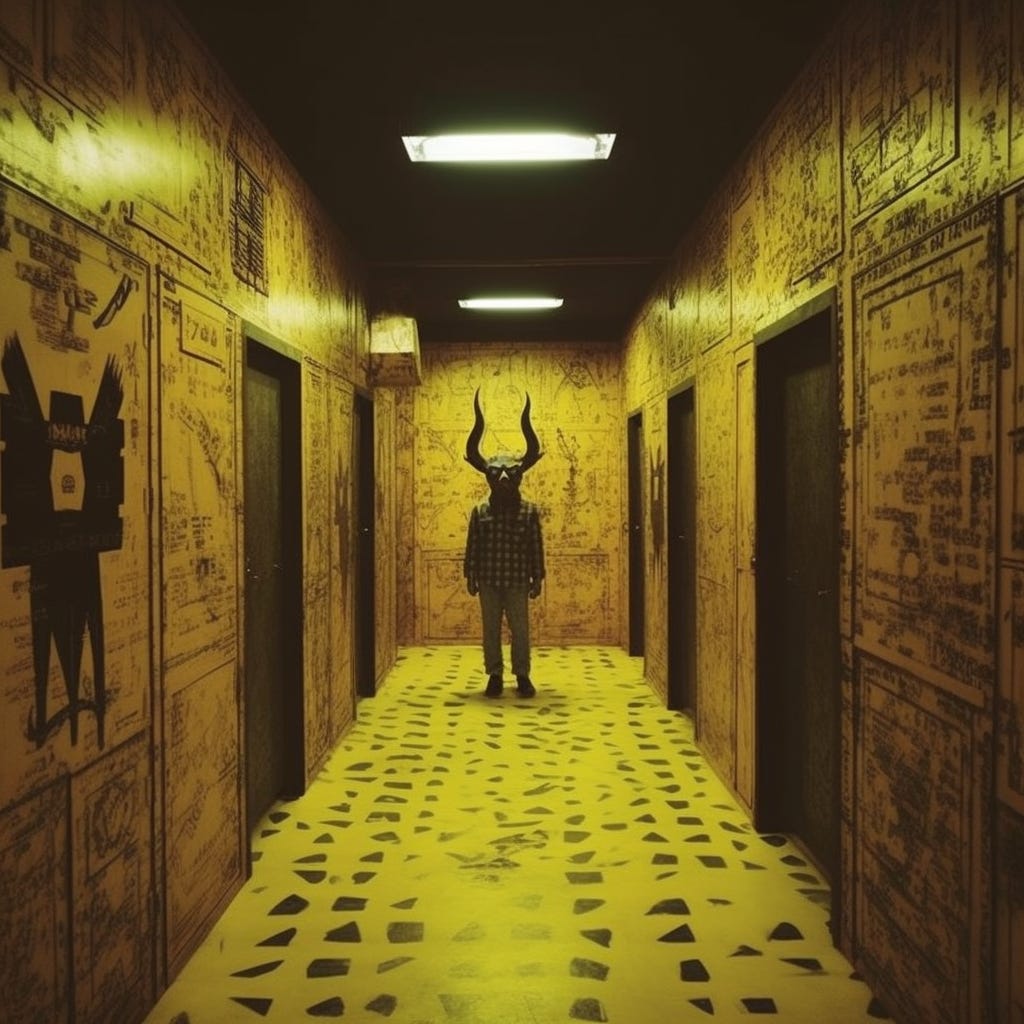
But the second I hit send on this email, I felt a tug of regret. Was this reply too try-hard? Had I over-intellectualized a stupid internet meme, turning a quirky 4chan diversion into the tedium of a college term paper?
Besides, I wasn’t even convinced that my analysis had any merit beyond the token cliché of first-year undergraduate psychology courses. In truth, if I was being honest with myself, I had only written the email out of a sense of obligation to a relative I barely knew and had never actually met, to make up for my prior, dismissive “Interesting!”
And now I felt like I had gone too far in the other direction. What I had written, it seemed to me, was just longwinded enough to demand a reply. Had I imposed upon this poor Zoomer girl such a boring obligation? Like I had given her a writing assignment?
So I was relieved, actually, when a few days passed and no reply came. She didn’t take my sense of needing-to-take-things-seriously seriously. Good for her! She was free to live her life, find a boyfriend, and play frisbee in the park with her dog. No need to submit to the game of churning out masturbatory, self-congratulatory, pseudo-intellectual bullshit to impress her cousin, yours truly, who had apparently done just that—crapping out an academic disquisition on the latest dumb fad in a ham-fisted attempt to stay relevant.
I gladly let the issue drop.
But then a message finally came. If I had assumed she was done with the Backrooms, I couldn’t have been more mistaken: she had, in fact, become more obsessed than ever. She said my Jungian analysis had sent her down a rabbit hole of research and reflection. But of course it had! She told me that she even planned to write a master’s thesis on the subject. She wanted to follow in my footsteps and do a graduate program in _____ .
I was touched.
Attached to the email was her application’s writing sample. She concluded by asking—humbly and with perfect tact—if I could look it over. Did it show sufficient academic rigor? Could I possibly give her feedback? Maybe suggest improvements?
Impressed by her enthusiasm and ambition, I immediately checked her sample:
The Backrooms Manifesto
A wall of text. I felt vaguely sick. Did I dare read it? I forced myself. My mind could hardly make sense of what I was reading. After a few paragraphs, however, she seemed to get her bearings, or maybe I got mine. One paragraph in particular jumped out at me:
Scholars, such as _______, have subjected the Backrooms to a Jungian interpretation, claiming its architecture to be archetypically related to the labyrinth of Knossos. Yet such a reading reduces our experience of the Backrooms to a kind of psychotherapeutic exercise and ultimately a vanity project in which we valiantly confront our fears in the deepest recesses of our self-conception—imagined spatiotemporally and in mono-yellow.
More recent scholarship maintains this Jungian analysis to be a mere comforting cliché—indeed, one that might have inadvertently contributed, Daedalus-like, to the construction of The Backrooms in the first place.
The prescribed therapeutic regimen valorizes the idea of confronting and subduing our inner demons only to make us more amenable to the logic of late-stage capitalism. In taming our monsters, we render ourselves monstrously tame, predictable, punctual, and ripe for exploitation by human resources departments and the demands of 24/7 e-commerce.
In Heideggerian terms, we become both the subject and the object of the instrumental mindset that reduces the world to a mere reserve for human manipulation.
Wait. What was this? My analysis was a “comforting cliché?” I had taken time out of my busy schedule to help her. To be kind, charitable, etc. She’s not even my student. And here she was, subjecting my off-the-cuff Jungian analysis to ridicule in front of admissions boards—and, brazenly, to my face. But not only to my face; she had the audacity to ask me to help her perform this mockery—to improve upon it. The impertinence!
And who provided this “more recent scholarship”? Was it her?
Besides, she was projecting onto Jung the attitudes and platitudes of stupid self-help books. If she had any fucking clue—
But then I paused. I bit my tongue. I counted to ten.
I reminded myself that I have thick skin. Yes. I do. The thickest. I reminded myself that I actually like the masochisms of academic debate—the rhetorical war—even if that debate is with hostile, juvenile careerists hell-bent on one-upmanship and greased-pole-humping ambition. I certainly didn’t mind being subjected to critical scrutiny, even when my ideas had only been protean and “off the cuff.”
No. It was better this way! She should consider herself a scholar in her own right and push back against the scholars she cites—even those that happen to be me—rather than unquestioningly affirm them. That’s what I tell my students to do, right? And she did it.
I gritted my teeth and forced myself to be proud of her. She had the guts to kick me in the balls for public entertainment and her own advancement. Fine.
I read on. I glanced down the page and found myself in the midst of another tirade. Her writing was decent, and mildly interesting, but far too polemical to be considered scholarly, I think:
One of the more salient aspects of traversing the Backrooms is the degree to which any sense of discovery is confounded.
Normally, we think that, by exploring the unknown, whether through a bathyscape, a galleon, or a lunar rover, we expand our sense of freedom and volitional control: we probe into vistas that have heretofore been forbidden to us; we subject them to our measurements and appropriate their resources to fuel further exploration.
At first, and to a trivial extent, exploring the Backrooms satisfies this peek-a-boo logic of revealing. We trod along virtually, unleashing more brain dopamine when we pass into that next anticipated room. Voila! It becomes revealed to us. And for a moment, we might feel trivially satisfied. But the revelation is a non-revelation: we only reveal the monotonous monochrome of more Backrooms.
In the Backrooms we encounter the enantiodromian counter-proposition to the logic of 24/7 e-commerce. It is the psychic penalty we inherit from hegemonic techno-modernity’s perpetual utilitarian instrumentalization of all things; it is the shadowy margin of Heideggerian enframing. The Backrooms invokes the liminal existence of the corporate gigaplex after business hours, tacky retro malls and office parks in burbs ghosted by white flight, airports at 3-am, obsolete K-Marts echoing with Muzak.
It is much the same with academia. Academic writing continues to accrue ever more rat-runs for its narrow readership under the momentum of long-term institutional commitments, resulting in alienating jargon, a rhetorical matrix that Žižek has—

I stopped reading.
It seemed like she was simply riffing on a set of unfalsifiable opinions fueled by teen angst.Academia is bad. Let’s apply to academia! If you say so, young lady!
There was more. Much more. A 25,000-word manifesto, which I will spare you. I skimmed it. I imagined her obnoxious boyfriend—probably some kind of dipshit Kaczynski or Linkola clone—had a hand in writing it. Or maybe not.
Perhaps I was still chafing under her dismissal of Jung. Maybe I was just tired of this whole episode. But I couldn’t be bothered to pick apart her whole document. No way.
I wrote one final message.
Dear A______,
Lots of neat stuff here. You’ve definitely been thinking about the Backrooms! But you might want to scale this back a bit since most admissions boards will not read past pages two or three. Also, it gets a bit preachy/polemical at times. You use the term e-commerce, which you fail to define, too much. Maybe reign it in under the usual academic standards and protocols. Good luck!
And that was the end of my involvement. Either she would be accepted to grad school or she wouldn’t. It was really no concern of mine. She was dead to me and I was happy to move on with my life. I made a point of deleting my YouTube watch history. No more Backrooms to nag me. I worked on my latest book. I worked on my golf swing and my tennis groundstrokes. I organized my sock drawer and rubbed my scalp with Minoxidil. I did some much-needed online shopping and wandered alone through halls and on Escher-like escalators in decaying light-industrial hellscapes.
 Scrivner's Pyre