Did Paganism Ever Really Die?[i]
Thomas Rowsell tweeted a quote from Carlyle a few days ago:
“I think Scandinavian Paganism, to us here, is more interesting than any other. It is, for one thing, the latest; it continued in these regions of Europe till the eleventh century; 800 years ago the Norwegians were still worshipers of Odin. It is interesting also as the creed of our fathers; the men whose blood still runs in our veins, whom doubtless we still resemble in so many ways.”[ii]
It is not surprising that Carlyle should harbor such sympathies. Though he did not identify as a pagan, his affiliation with the natural religion of his ancestors makes sense considering his disdain for the industrial-scale Mammonism, materialism, and utilitarianism of his day.
When I read nineteenth-century writers like Carlyle (or Thoreau, etc.) complaining about modern life, I always think: if only they could see us now! If they could only witness what we have become, locked in our air-conditioned consumption units, desires spawned and mediated by the rectangular glow of various TikTok twerkings—what on earth would they think?
Yet we are captive and castrated not only by our technological realities, but also by postmodernity’s universalizing tendencies, by its insistence that everything about the past—everything before postwar neoliberalism, is morally scary. We must reject it and resign ourselves, the story goes, to becoming more like individual Funko Pops: superficially different but otherwise identical, mere reflections of current consumer culture, trinkets wide-eyed and in-the-moment, brainless.
Those of us who feel Carlyle’s instinctive attraction to the ancestral religion, but who also pursue it to its depths, tapping roots below this nutrient-deprived topsoil, will find “new meaning in life,” but also new struggles.
One such struggle relates to the 800-year disconnect that Carlyle references above. Those attracted to pagan beliefs often feel they are reanimating the DNA of an extinct species. Even if we feel inclined to embrace paganism, how exactly is that accomplished in practice? We might feel that Odin resonates with us, but can we really go back to calling him our god after so long an estrangement? For many, this centuries-long barrier makes the whole project of our pagan renaissance seem larpy and unnecessarily difficult. We may as well be trying to text our friends in Linear A.
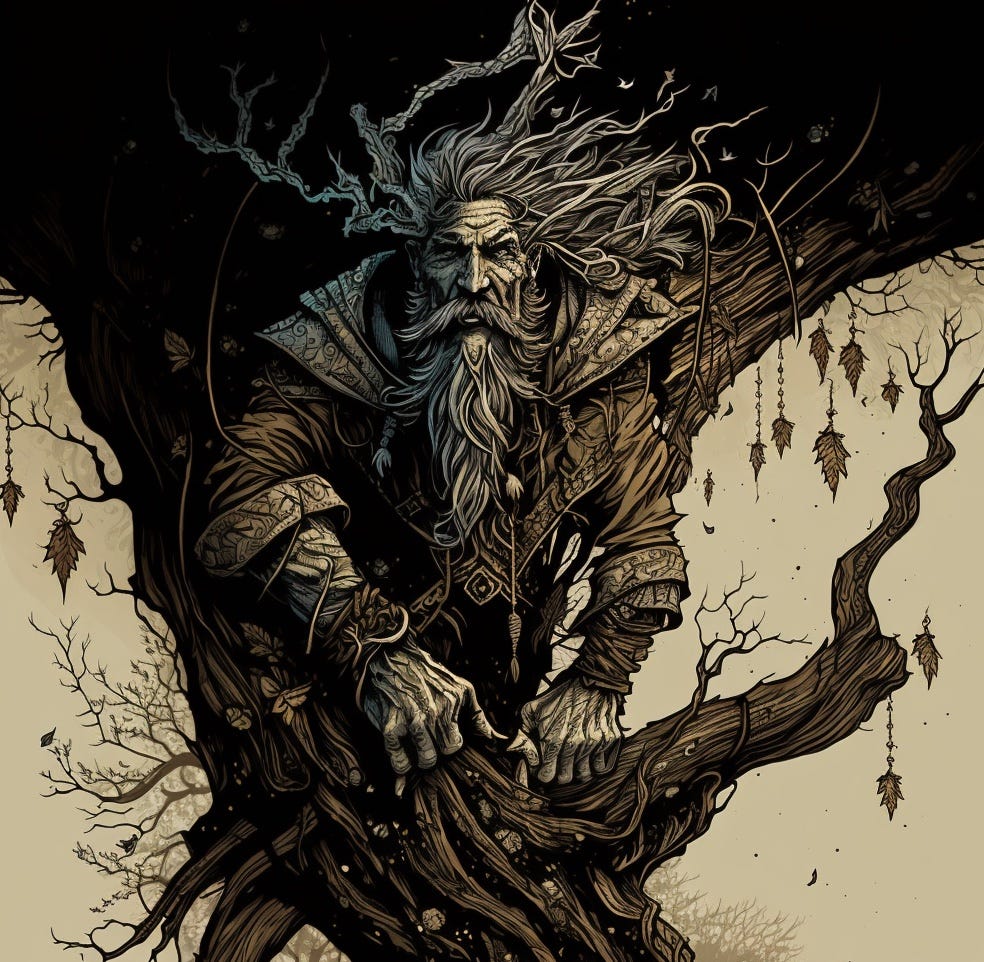
Meanwhile, Christians have it easy, we’re told. They have the past 2000 years to draw from, we’re told. “If you’re so keen on re-rooting yourself, why not just be Christian, since that was the creed of your nearest ancestors?”
One problem—of many—is that Christianity, like postmodernity itself, is universalist and universalizing. It does not accommodate the kind of ancestor cult that we seek as naturally as paganisms effortlessly do. Moreover, the Abrahamists’ god’s jealous insistence that we have no other gods before him betrays an insecurity and vulnerability unbecoming of a god.
But we can be like our Christian kin in a particular way: just as they rejected the religion of their sun-loving, poetry chanting, ancestor-worshiping pagan ancestors at some point in our family’s history, we, like them, must reject. But the object of our rejection must be their prior rejection…So that we might re-embrace the loving embrace of our tribal roots.
But cheekiness aside, perhaps a slight adjustment in our way of looking at the issue will reveal that pagan religion might not be such a long-dead cadaver after all, which may help us, when we gather in IRL meat-spaces, to feel less like we’re hanging out with the Society for Creative Anachronism types at the student union.
II
But what of these supposed 2000 years of Christian hegemony that, for some, form an impenetrable wall, beyond which it is LARP to trod?
Let’s first note that, as even Christians themselves will lament, Christianity’s establishment has never been universal nor anywhere close to two millennia in duration. Christianity was still a persecuted underground cult for many hundreds of years in the Roman world before the Constantine. And the reign of Emperor Julian reminds us that, even after Constantine, the dominance of Christianity among the elite was widely contested by practitioners of the older faith.
Edward Watts’ fascinating book The Final Pagan Generation illustrates the reality of that period. Far from being a grassroots revolution springing from the populus Romanus, the spread of Christianity in the empire was largely seen as a project of Constantine himself. Watts notes how the final pagan generation in the Roman world didn’t take seriously the cultural revolution that was devolving from on high—until it was too late.
Still, such was the rivalry between pagans and Christians that when the Goth’s sacked Rome in 410, the two groups blamed each other. Pagan Romans thought the new religion had weakened Roman society, thus inviting the invasion. Meanwhile, Rome’s Christians insisted the calamity was a sign of God’s wrath over the fact that so many Romans still stubbornly clung to the old religion.
This is in 410, mind you. Or as I like to call it, 1163 AUC. We’re chipping away at that 2000-year wall.
Centuries passed and still the north and east of Europe held fast to paganism, deep into the Viking age. Books like How the Irish Saved “Civilization” (scare quotes mine) chronicle the precarity that Christians faced for many hundreds of years in the desolate north, lone outposts in a sea of heathendom.[iii]
So now we have cut the “2000 years” roughly in half, and we’re still not out of the pagan woods, so to speak. Vast swathes of Scandinavia, Russia, and the Baltics continued to hold fast to the old religion past the year 1000. Indeed, Christianity didn’t get firmly established in Sweden until the 12th century. It didn’t eclipse paganism in the Baltic regions, among the Old Prussian nobility and the Dukes of Lithuania until the late 14th century.
And in the ensuing centuries, even after the oft-coerced conversion of the nobility, generations of folk of the Baltic regions—typically rural folk—continued to embrace the faith of their ancestors, underscoring the original Latin meaning of the word “pagan”—i.e. rustic, provincial.
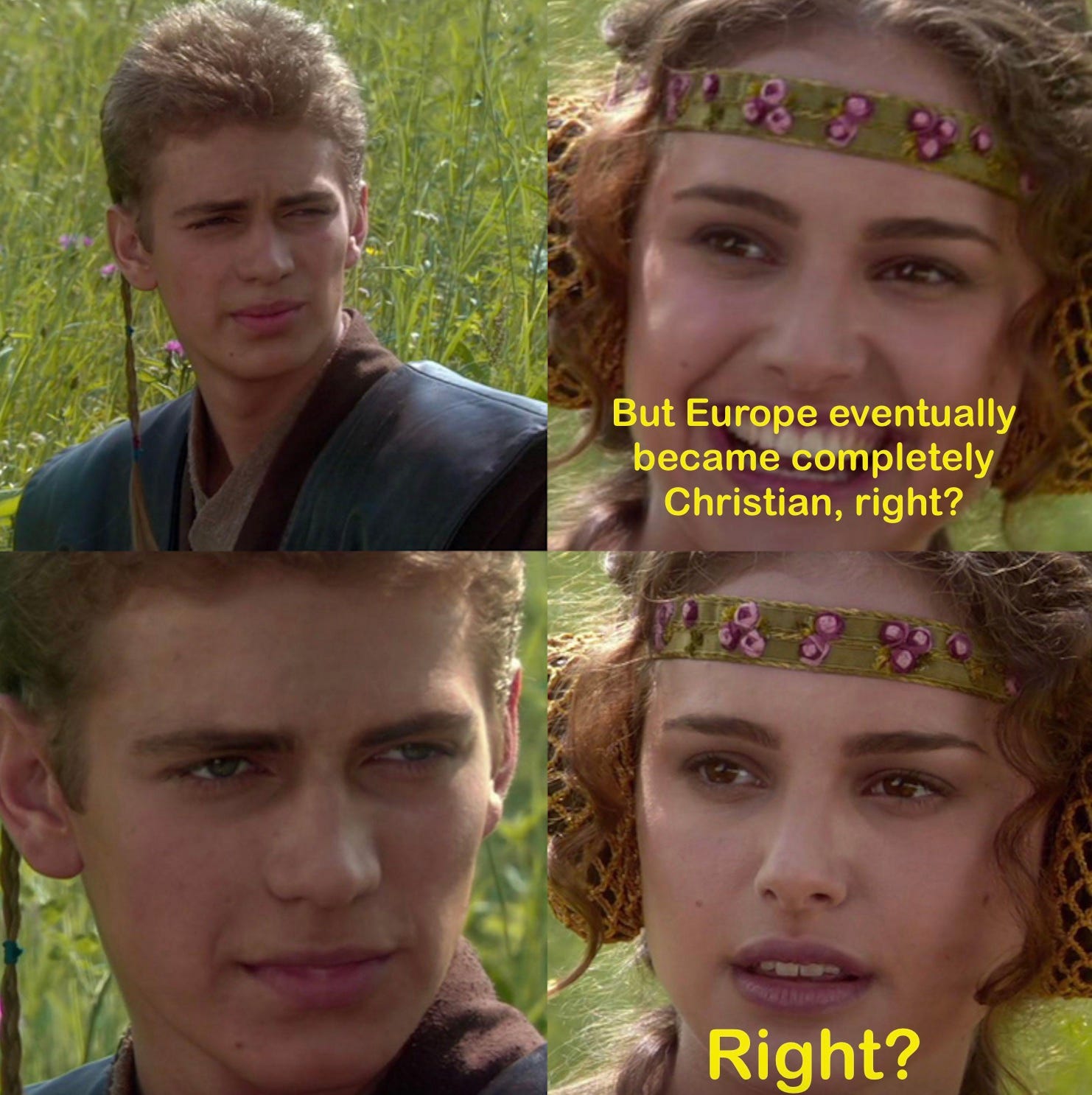
But pagan Europe eventually succumbed, did it not?
Well, no. Precisely as the final generations of pagan kings were fading in Europe’s northeast, a rebirth of paganism was underway in the power centers of the west.
III
It is hard to imagine the impact that Gemistos Plethon and his circle had on European civilization. Born in the middle of the 14th century, Plethon rejected Christianity and promoted the revival of classical paganism and the worship of the old Hellenic pantheon—a dangerous proposition in those days. If this were the extent of his revolutionary mindset, he would have been dismissed as a kook, and an anomalous quirk of history.
But Plethon wasn’t just a reclusive, navel-gazing, philosopher-scholar. He was a man of energy and action. In the waning days of the Byzantine Empire, with the Turks at the door, he moved from Constantinople and eventually ended up in Italy, bringing with him his vast knowledge of classical paganism. In Florence, Cosimo de’ Medici fell under his spell, prompting him to found the Florentine Platonic Academy, a loose knit group of a hundred men dedicated to reviving learning and encouraging the rediscovery of the texts and practices and gods of the ancients. The Nomoi, Plethon’s main opus, which survives in fragments, covers a wide range of subjects, including the nature of the gods and questions of cosmology.
The accomplishments of Plethon, let alone those of likeminded revolutionaries of that period, are too numerous to list here. But, briefly, let’s drop some more names.
There was Julius Pomponius Laetus, who in the 15th century founded the Academia Romana, which promoted the recognition of Roman rituals and festivals and the adoption of classical pagan practices. Such was Laetus’s fervor for all things classical antiquity, and such was his religious veneration of figures like Romulus, that Laetus and twenty of his followers were arrested and tortured, accused of “promoting paganism.”[iv]
Also at the Academy was Marsilio Ficino, who’s Theologia Platonica reintroduced Plato to Europe, as well as the idea that the philosophy of pagans could be taken as a guide to life rather than a mere intellectual exercise.[v]
There was Giovanni Pico della Mirandola, another Platonic Academy affiliate. His Oration on the Dignity of Man, widely acknowledged as the Manifesto of the Renaissance, propounded the glory of the Greek pantheon, proclaiming that“Apollo illumines every soul as it enters this world.”
There was Giordano Bruno, who promoted pantheism and the cosmological theories originally set forth by the pagan scholar Aristarchus of Samos. Part of the great Copernican controversy of his day, Bruno’s heresy served to undermine Christian authority and open Europeans’ minds to the possibility of other worlds. Galileo might have escaped execution for his crimes against Christian dogma, but sadly Bruno did not.
We could go on. In short, the Italian Renaissance was a breath of fresh air, inspiring new forms in poetry and the visual arts, new discoveries and innovations in architecture and anatomy and countless other fields. But the revolution was not confined to the centuries now termed the Renaissance Era. It continued through the ensuing centuries in the operas of Jean-Baptiste Lully and Richard Wagner; paintings like the Birth of Venus signaled a birth of the old gods that would persist through neoclassicism and beyond.
IV
But this isn’t real paganism, naysayers might object. It’s just the scribblings and prayers of eccentric enthusiasts and hobbyists. But paganism does not rely on princes and popes for sanction or sanctification. It doesn’t need to shutter St. Peters and establish a religious power center down the street at the Pantheon—as interesting as that would be. Paganism springs up from the soil and weeds. It echoes in the forests and groves, in our comedies and our tragedies. It loosens the rein on the human spirit, allows it to pursue life whither it will, untrammeled by the control of power-brokers and dogmatists.
Besides, who’s to say that the god the Abrahamists honor, whom some call “heavenly father,” at the end of the day, and unbeknownst even to them, isn’t just Dyēus Pətḗr after all?
Works Cited
Carlyle, T. (1897). On Heroes, Hero-worship and the Heroic in History. New York : London: Macmillan Company.
Greswell, W. P. (1805). Memoirs of Angelus Politianus, Joannes Picus of Mirandula, etc. . London: Cadell and Davies.
Marco Piana, M. S. (2020). The Way Philosophers Pray: Hymns as Esperimental Knowledge in Early Modern Europe. Mediterranea. International journal on the transfer of knowledge, 51–89.
[i] NOTE: This article does not pretend to be anything more than a generic overview. It clearly does not go into detail about the kinds of paganism we are potentially talking about. It doesn’t really go into what paganism *is* ideologically or practically, or how it might help orient one to life or death. It was not written to those already satisfied with their chosen “path.” It is an appeal, perhaps, to the fence-sitters, to those who might be curious about this thing called paganism, but who are squeamish about involving themselves in something they see as anachronistic or mummified. I want to show them how it never died.
[ii] (Carlyle, 1897)
[iii] Though let’s give the monks credit for helping to salvage Beowulf and the Eddas, etc., from oblivion.
[iv] (Greswell, 1805)
[v] (Marco Piana, 2020)
 Scrivner's Pyre