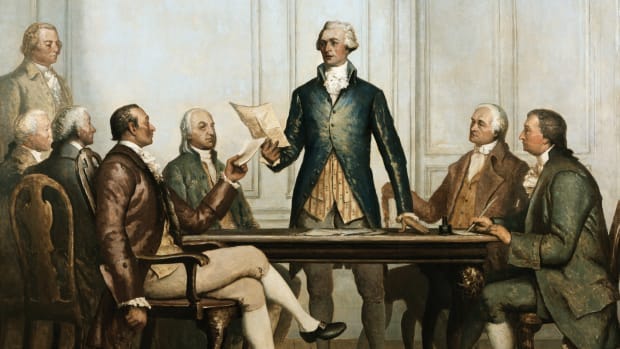
America has been called a “proposition nation.” Those who promote this idea believe that belief is all it takes, really, to call yourself an American. Just say the pledge, wave the flag, sign the documents, believe in freedom and personal liberty and personal responsibility and “rights;” then just recognize the world as naught but a commercial zone for boot-strappers and be quick to call in an airstrike in a few middle eastern countries to spread said beliefs—and you will be OK. You’ll have been recruited into the ranks of the American empire, “The West.™”
Others believe otherwise—believe that belief per se is not enough. They think that not only can belief be faked by those wanting to gain entry into the American system, but that this laundry list of things we are supposed to believe as Americans—or westerners in general—has itself been co-opted and weaponized against us.
Civic nationalism promotes the primacy of belief. Non-civic nationalism negates it.
But today I want to have a different, but related, discussion on the question of belief.
Ahem. Permit me to get mundane:
I always thought it was a bit strange how everyone starts their day in pretty much the same way. They shower, get their socks on, see the kids off to school, make coffee and go to work. More or less the same routines—even among people with vastly divergent worldviews. You have atheists doing this. You have Muslims and Hindus and Mormons and pagans all doing this.
But this isn’t going to be some “we’re all the same,” “we all bleed red,” “brotherhood of man” appeal for universalism. No. I just want to show that the vast majority of people’s daily routines are not determined by their overarching belief system. This is the obvious first step introducing my motif—namely, that I think the idea of belief itself should be taken off its pedestal.
Not to belittle it. Not that I don’t think we should have beliefs. I just want to take “belief” down a peg so I can see it better.
I think belief should be subjected to heightened scrutiny, or inaugural scrutiny—because scrutiny never actually seems to happen. Never has happened. Not really. What we usually end up talking about when the issue of belief is raised is the object of our supposed belief—whether we believe in an anthropomorphic god, or global warming or aliens or evolution or unbridled neoliberalism. We end up engaged in a debate about the objects of belief. We end up talking about the merits or reality of those things—whether the gods are real as physical entities or concepts or energies, or whether the Moderna vax works or is a scam, or whether nothing exists and that nihilism reigns. We never interrogate the ground of belief per se. We almost never ask, well, what is this thing “belief.” What is it like to believe something?
We think we know. We say: what we believe is what the evidence has convinced us is true. WRONG!
But—but don’t we cling to worldviews until something comes along to convince us otherwise? If I am keen on the geocentrism of Ptolemy, for instance, will it not form a foundation for my belief system until Copernicus or Galileo come along with their proofs of heliocentrism? Maybe. But can we extrapolate that kind of approach to reality into a religiosity? Religious belief? It wouldn’t be much of a belief system if it remains so always up for grabs.
Only because: such an attitude keeps us ever setting the table for the feast, and never sitting down to actually eat. We would be always on the lookout for new arrivals that must be accommodated with new placemats and silverware.
This is precisely why a lot of religious people mean the opposite of this when they talk about their beliefs—namely, that their beliefs are that which they assume to be true despite the lack of any proof, despite a gale force wind of contravening evidence, and regardless of new evidence.
This allows them to get past the preliminaries. They embrace a set dogma and start the real business of living.
Many religious people take this tack. And good for them. Some assume they are participating in a grand test, a Pascal’s wager, where they will gain reward for staying steadfast in their beliefs about god despite living in an empirical blind spot. But I guess whether you see such evidence or not rather depends on the kind of god we are talking about.
In the absence of a particular kind of god, we pin our hopes that he is a particular kind of absent god: the right choice of faith-in-god per Pascal’s wager seems to presuppose that this god will reward his believers for believing in him. See my discussion of Pascal’s wager here.
And many—perhaps most people—tend to pretend to have some beliefs that, upon the deepest levels of self-reflection, they sometimes admit quietly to themselves that they don’t believe. They say they believe this or that nonetheless for social brownie points, or to avoid being ostracized. Ostensibly adhering to some political beliefs about history or COVID or race relations might keep you from getting fired. Historically, religious belief has been similarly indicative of social standing. Belief becomes a kind of password or a shibboleth.
But it is easy to fake belief. It is hard to fake a physical process. Belief is metaphysical, and subjective, and thus is impossible to be independently verified.
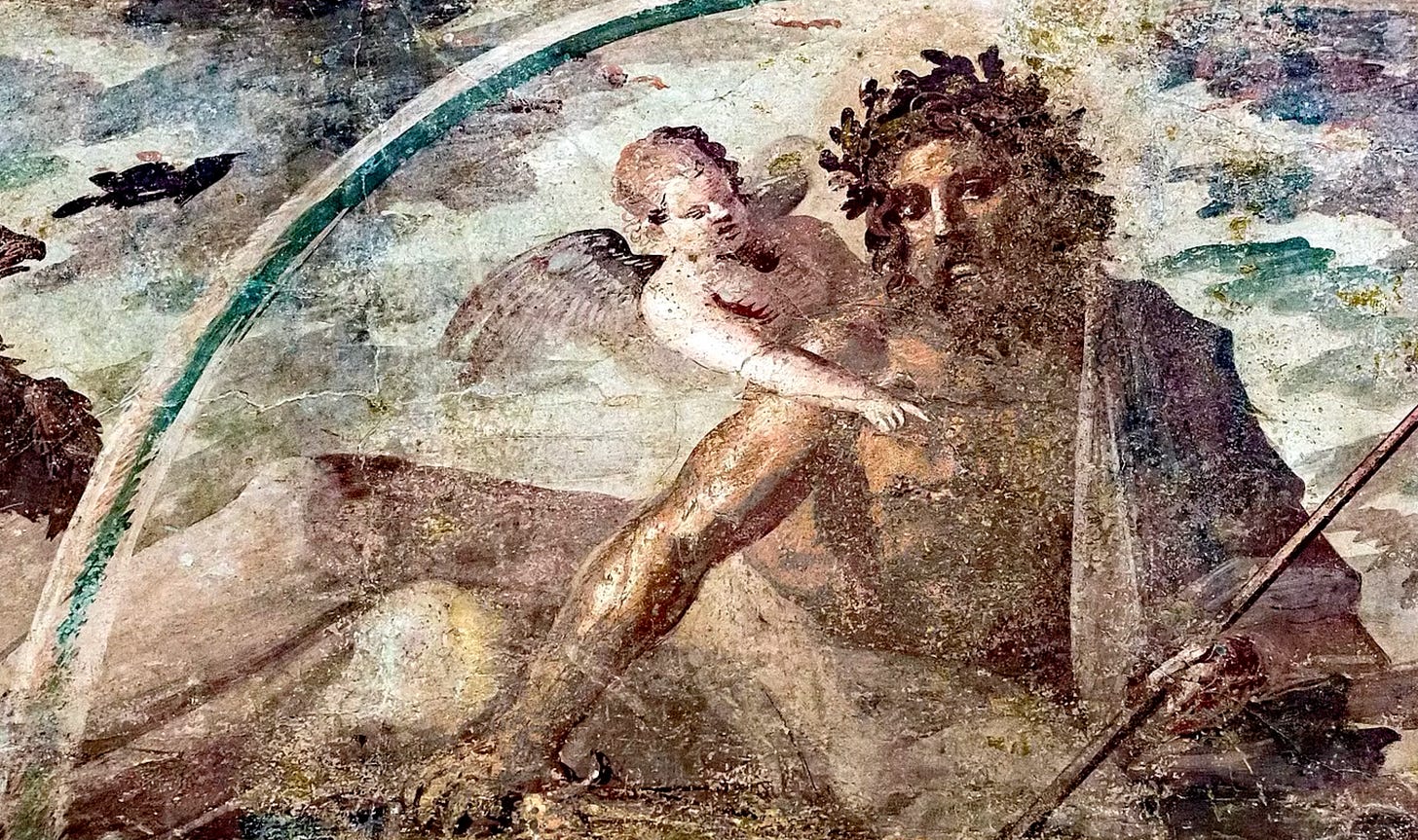
So I like to look at people’s beliefs not in terms of whether they are true or false but as William James looked at them. What does professed belief do for people, for communities of people? In the short term? Over time? I find such questions infinitely more interesting than the question of whether or not the thing that is believed is “true.”
This is a very pagan understanding of belief. The ancients cared far less about whether or not there were really anthropomorphic entities out there in the sky than they cared about what deeds were done in their name. Ontological status prostrates itself to heroism.
Nietzsche, too, promoted philosophizing with a hammer, building and destroying ground instead of passive reflection on the chimeric grounds of belief.
All this is not to say we should have no beliefs. I still have beliefs. But one of those beliefs is the belief that belief is secondary, or should be, and that what is primary is action, doing—the get ‘er dun.
Pray to your ancestors first if you can’t yet conceive of praying to your ancestors’ gods. Seek out collective ritual irl – the gold standard. We larp until that praxis knits us into a system of belief.
We fake it till we make it.1
 Scrivner's Pyre