I
A few hours after Elon Musk tweeted today, with ostensible schadenfreude, “The Branch Covidians are upset,” he appeared onstage in San Francisco with Dave Chappelle, which caused a “major fight” (Musk’s words) to break out in the audience. It seems like wherever he goes, Musk summons Discordia.
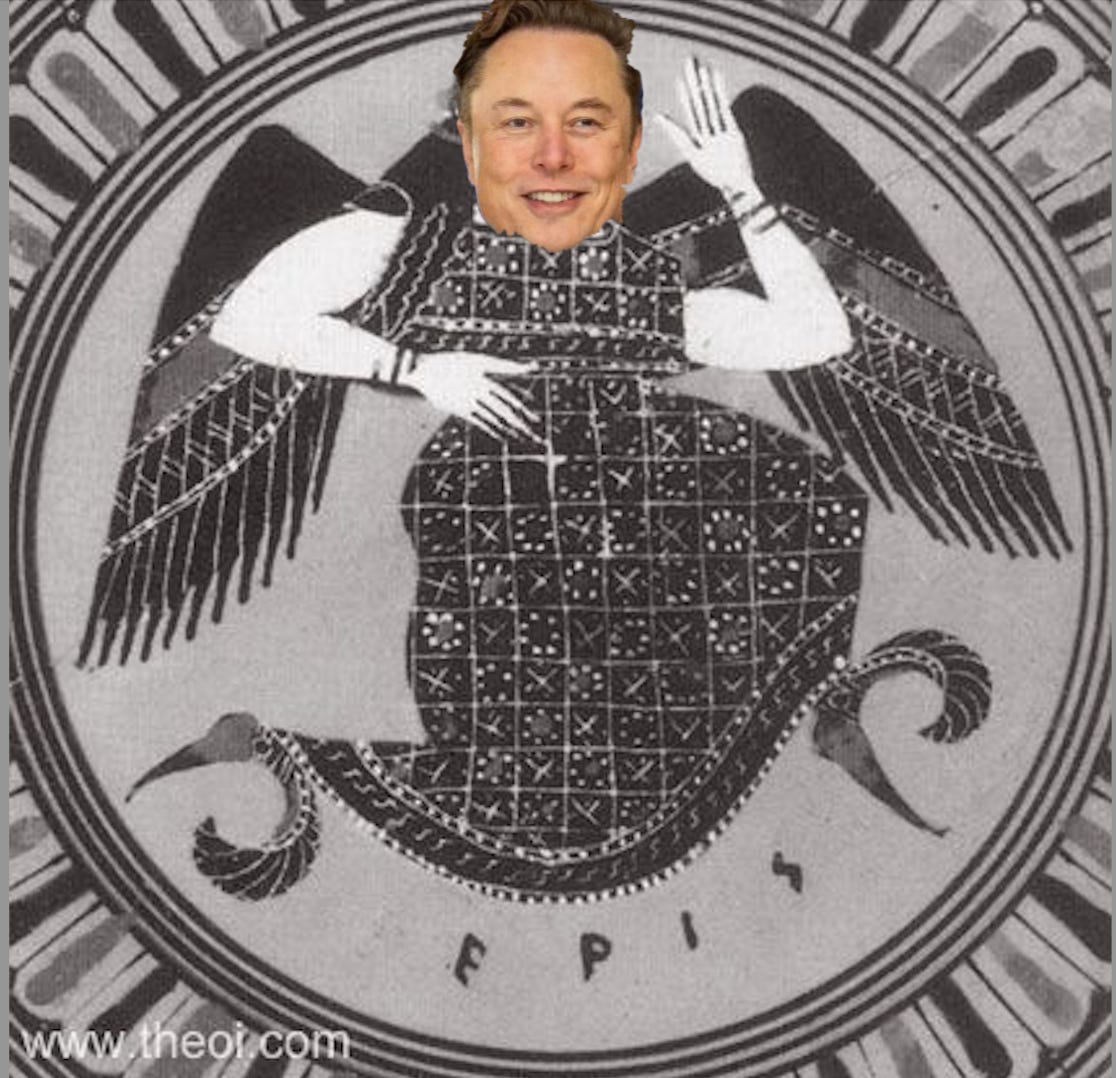
Discordia is a Roman goddess often associated with discord (of course!), marital strife, fisticuffs, etc. But, as with most things in pagandom, she has a dual nature—there is, in fact, an upside to discord.
For while conflict seems inevitable in a world in which Hobbesian competition for scarce resources reigns, while language is “imperfect” and leads to misunderstandings, and while some people just like to fight, the fact is, without a sense of competition or conflict, we might not have even come down from the trees.
From the most bitter rivalries come the greatest achievements, whether we are talking about college football or incandescent lightbulbs.
The goddess Discordia prompts you to get out of bed earlier than you otherwise would have, with the knowledge that, if you sleep in, someone else will be promoted ahead of you at your workplace or the enemy army will cut off your supply lines. It’s what keeps you on your toes and what, indeed, accounts for the molecular structure of the universe, as has been acknowledged since ancient times.
How so? You ask. Read on.
II
The pre-Socratic Greeks were the original devotees of Discordia—whom they called Eris. They discovered strife everywhere they looked. The Greek kosmos was described as a physical world in an everlasting alternating movement or “war” between opposites. These dualistic oppositions were soon subdivided yet more, into quadrants, the classical elements: fire (hot and dry), water (cold and wet), air (wet and hot), and earth (dry and cold). These elements were locked in an unending self-correcting balancing act, a reconciliation of opposed forces and tendencies.
Aristotle cites the pithy sayings of Heraclitus to illustrate this concept of such an oppositional cosmos. Heraclitus describes a place where “it is what opposes that unites,” where “from different tones comes the fairest tune,” and where “all things are produced through strife.”
Euripides too, according to Aristotle, suggests a world bound mainly by of interactive contraries in flux, where “parched earth loves the rain, and stately heaven when filled with rain loves to fall to earth.”
Why do I take the trouble to expound the long-dead physics and philosophies of the ancient Greeks? You might well ask.
Because of course such a physics isn’t really dead at all: It forms the wellsprings of empiricist science and the modern world that came of it. As the ancients differentiated air and fire, scientists of today subdivide the natural world into ever-smaller constituent parts, where still they find the same oppositional structure that the Greeks found.
The same tensions that dictate nature’s periodicities—the ebb and flow of tides, the succession of day and night, the systole and diastole of breath—are present even at sub-atomic levels. The electron and the proton have oppositional charges, pulling elements into their particular configurations in an endless balancing act.
This Heraclitan “war” of forms, where “all things are produced through strife,” has correlates in evolutionary biology, too: It is precisely the animal’s competition with other animals for survival that leads, through evolution, to the form that that animal takes. The horn on the ram, the skunk’s stink, the octopus’s ink—all the wonderful multifarious richness of nature comes of beings’ war with their surroundings, their predators, their competitors for mates.
All form can thus be seen as based on the dance or interplay of oppositional differentiation at every level, micro, macro, and meso. The universe is at war with itself. And for this we should be eternally grateful, for otherwise it would cease to exist.
III
Civilization emerged through this strife, like the stag’s antler. This is not simply a reference to the clashing of armies that gave rise to its constituent states. Our civilization is the product of competing ideologies, a discursive war.
But the anti-civilizational elite who run the Anglophone west and its vassals would like us to think that the war has ended, that history has ended, that science is settled—for they take any counter-propositional statement as an affront, as a threat to their hegemony.
They thus have tried to end the oppositional war of ideas itself.
But it never really ends. While they propagandize you with the idea that all competition is bad and that you should foreswear it, they try to out-maneuver you to delete whatever it was (now past tense) about your point of view or civilization that made it different, distinct, or interesting.
Thus the alphabet soup hegemon will accuse you of spreading “Russian propaganda,” or “hate speech,” or “misinformation” in an effort to simply shut you up, all the while yammering about “civility.” How is it civility to stifle your civil right to say what you think? These actors claim to be “nice,” but their soft hands strangle the goddess.
IV
Back, now, to Elon Musk.
Musk can be seen as an avatar of Discordia. He has become her champion. But his devotion to the goddess goes beyond the trivial mean tweet. As has been shown in the most recent Twitter Files, mean tweets or online threats of violence do little to raise the ire of the establishment when their authors are ideological allies.
No. Musk is a real devotee because he has brought, or has tried to bring, Twitter back under the reign of Discordia. He has tried to make it a place of legitimate strife, rather than a fake forum of hegemonic niceness.
It is instructive that, the more powerful Musk becomes—and especially since his takeover of Twitter—his critics have sharpened their attacks. No longer is he a mere merry shitposter or Lokian trickster. Now Musk is a serious threat: “becoming as divisive as Trump.” The “man who wants to build a colony on Mars is splitting society on Earth.”
As Musk threatens to make Twitter a temple sacred to Discordia, the system’s shills will try to shut it down. They have recruited international capital for a massive corporate boycott. They want no god to rival their pampered, decaying, monovocal self-importance.
They might as well just allow for open debate, though, right? If they are really as right as they say they are, the world will soon know it. Why not have that debate?
Why not come dance with Discordia and her new, blue, avian familiar spirit.
 Scrivner's Pyre